Yonah Riel
The Non-Binary Botany Lesson:
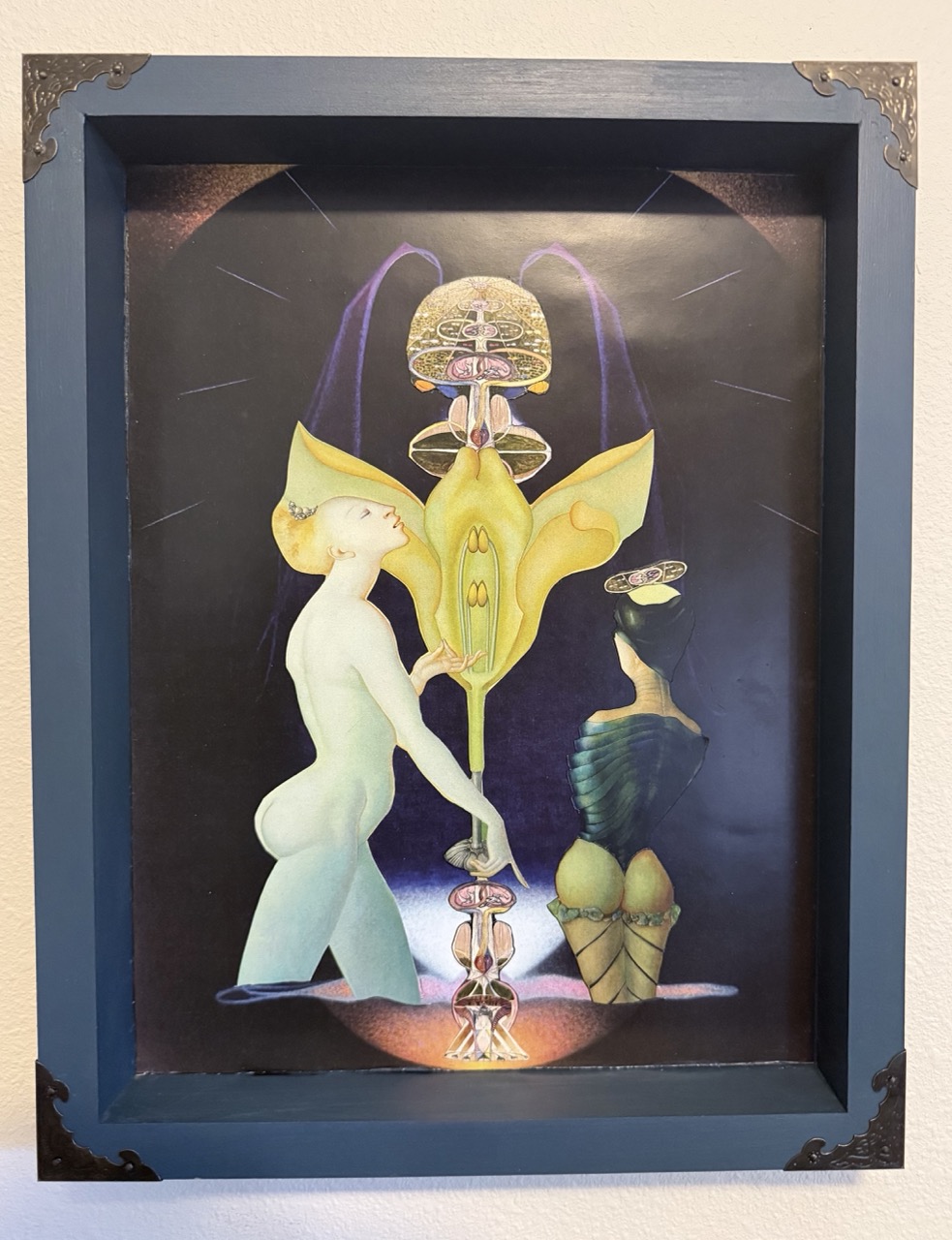
A tribute to Agnes Pelton, Leonor Fini and Hilma af Klint
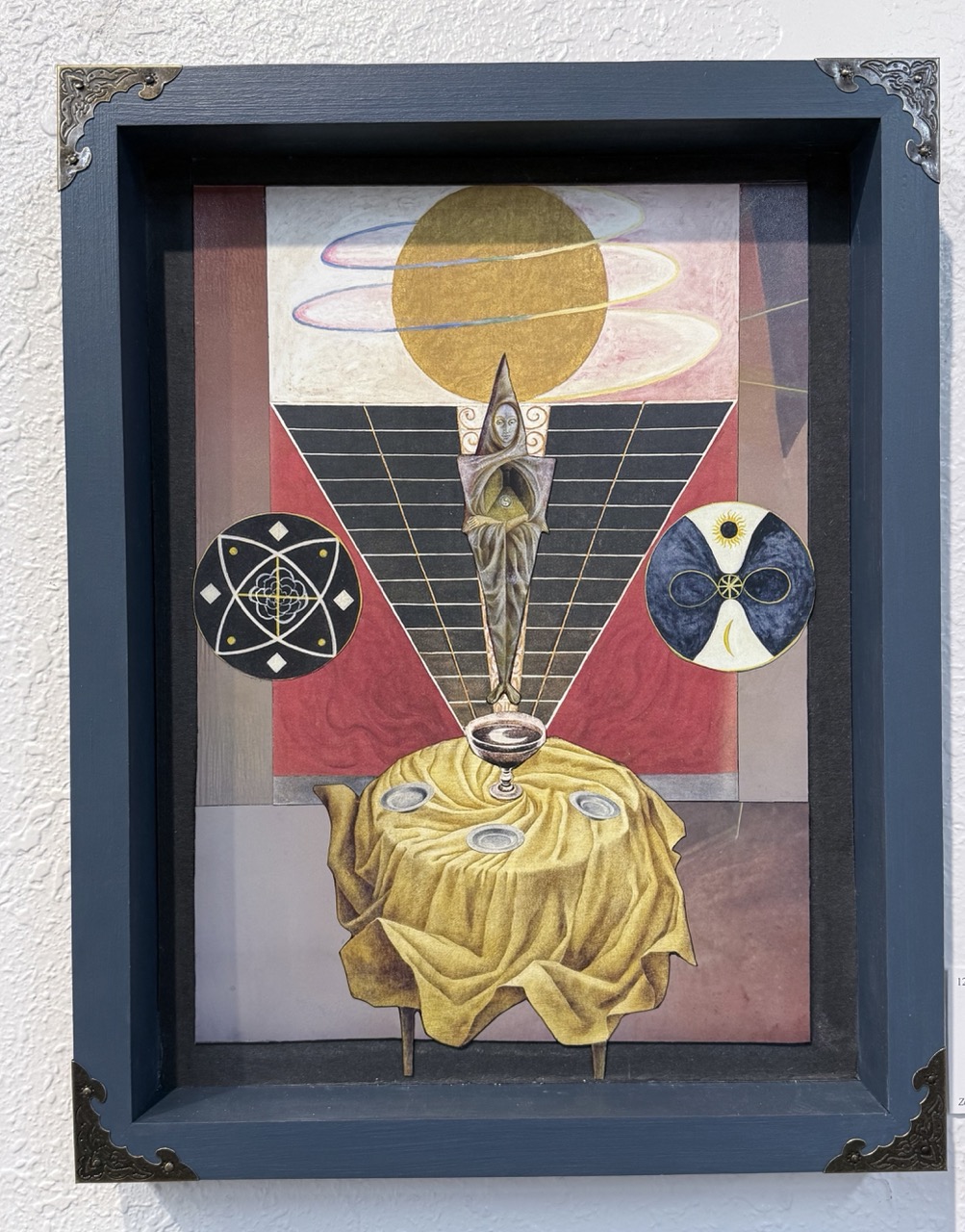
Two figures rise from the golden cauldron — one fully formed, ivory and certain; one still shelled, still deciding what she will be. Between them moves an energy neither can claim alone. The figures are drawn from Leonor Fini's The Botany Lesson(1974).
Out of the cauldron rises that unformed energy - the cauldron and the purple spires rising at the top are drawn from Agnes Pelton's Alchemy(1937-39). It passes first through the heart chamber, where blue and yellow transform into a passionate rose, then two doves emerge: proof that difference, tangled together generates life. Then the energy blossoms into a golden calla lily, its ovaries and pistils exposed - the alchemical process made visible.
But it doesn't end there. It rises once more into the mushroom - the fruiting, composting form, drawn from Hilma af Klint's Tree of Knowledge series (1913-1915) — where the flower's information breaks down and disseminates. From the mushroom, purple spires are back down, carrying that dissolved information to the bowl again.
Two becomes three becomes one again.
Beauty and the Beholder
A tribute to Leonor Fini, Hilma af Klint and
Georgia O'keeffe
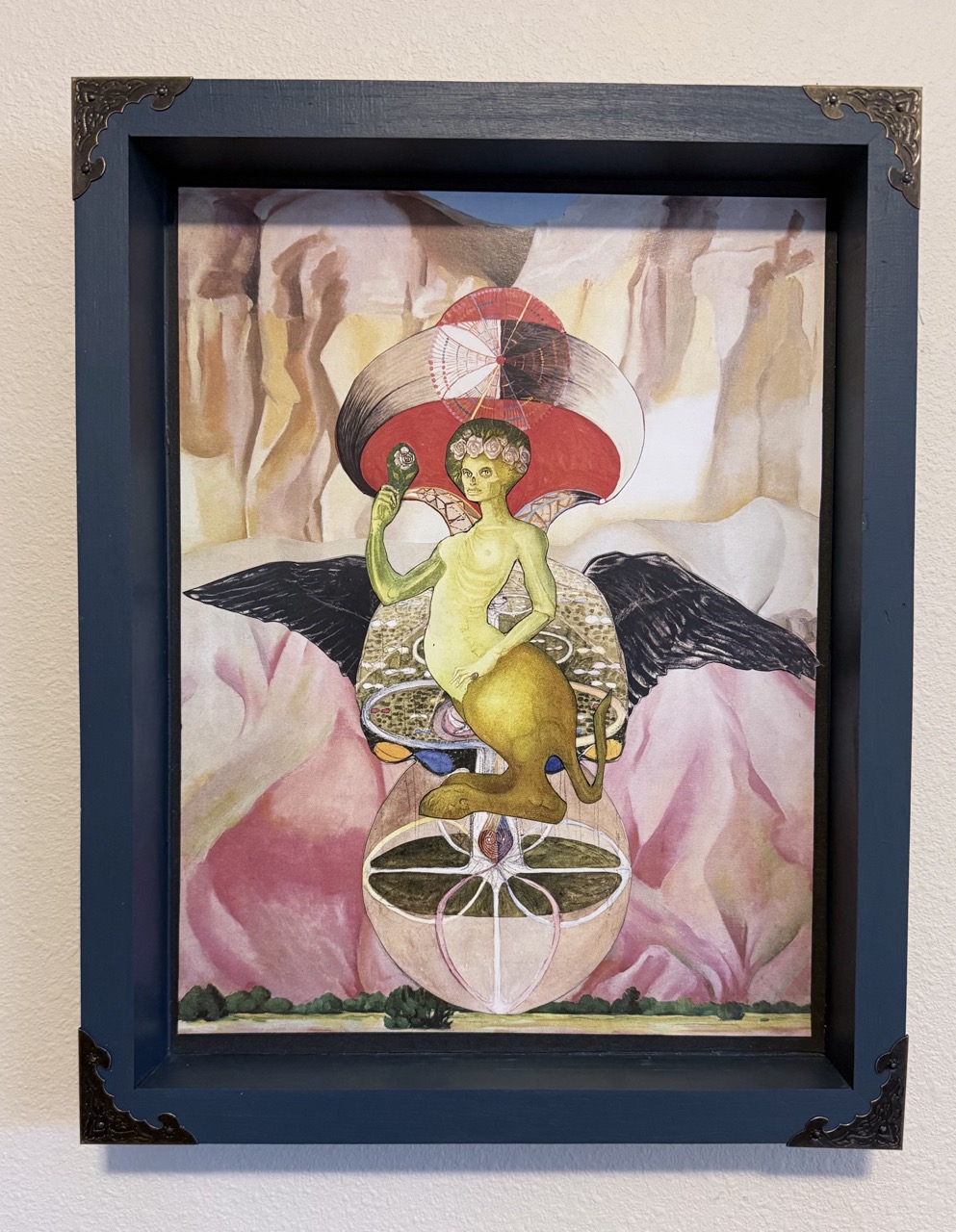
The sphinx has always guarded the threshold between what is known and what must be learned through riddle. She rises here from Hilma af Klint's Tree of Knowledge, #1 (1913-
15), while her wings and the crowned disc above her head are drawn from two versions of af Klint's The Swan; #1 and #9 (1913-15). Her body comes from Leonor Fini's Sfinge la morte
(1973), regal and unhurried, entirely at ease with her own strangeness - a sphinx who wears death itself as one more riddle to keep.
Behind her, Georgia O'Keeffe's Cliffs Beyond Abiquiu (1943) stands watch - ancient, sun-worn, indifferent to the mysteries unfolding at their feet. She does not ask to be understood.
She asks only that you look - and in looking, that you become willing to be changed by what looks back.
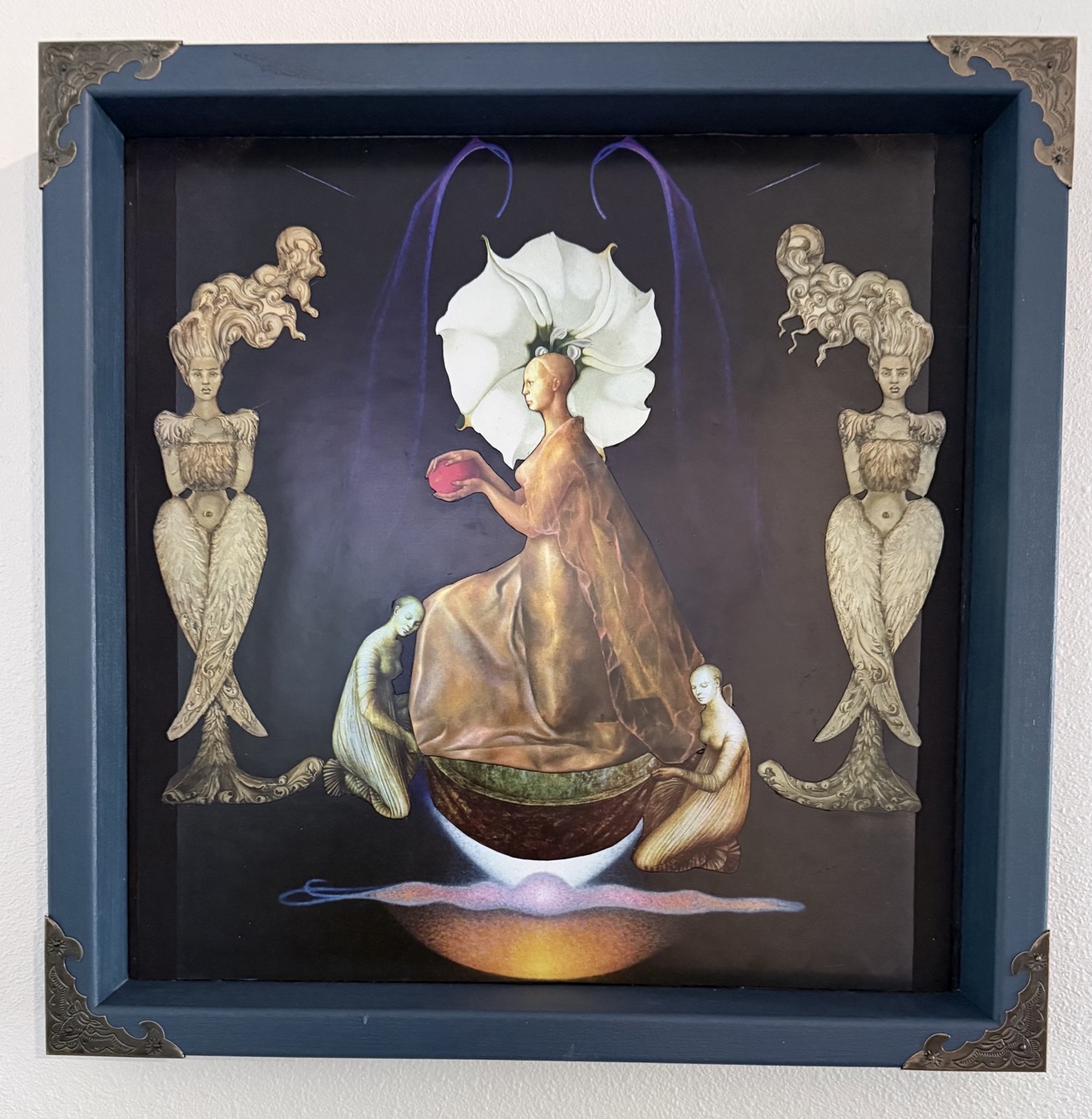
The Creators: A Tribute to Agnes Pelton, Leonor Fini and Georgia O'Keeffe
Alchemy is underway before the eye even knows it — Agnes Pelton's Alchemy (1937) vibrates beneath the surface, emanating translucent light from below. Rising from that glow, a figure in a shimmering dress made of light, rendered with a mastery that seems to generate its own radiance. She is Leonor Fini's The Guardian of the Red Egg (1955), caught in the act of gifting that which she has birthed, the red egg cradled in her hands. Behind her, Georgia O'Keeffe's Jimsonweed
(1936) opens like a second sun, the whole scene shifting our consciousness even as we witness it. At either side stand two guardian witnesses, cut from Fini's Anthropomorphic Wardrobe (1939).
Unyielding in their catlike beauty, the sphinxes ensure the ritual will be honored. Below, two attendants from Fini's Le Voile (1956) lift the veil into place, completing the rite.
Unmoored, at midnight in love:
a tribute to Lenore Fini, Agnes Pelton, and Ithell Colquhoun
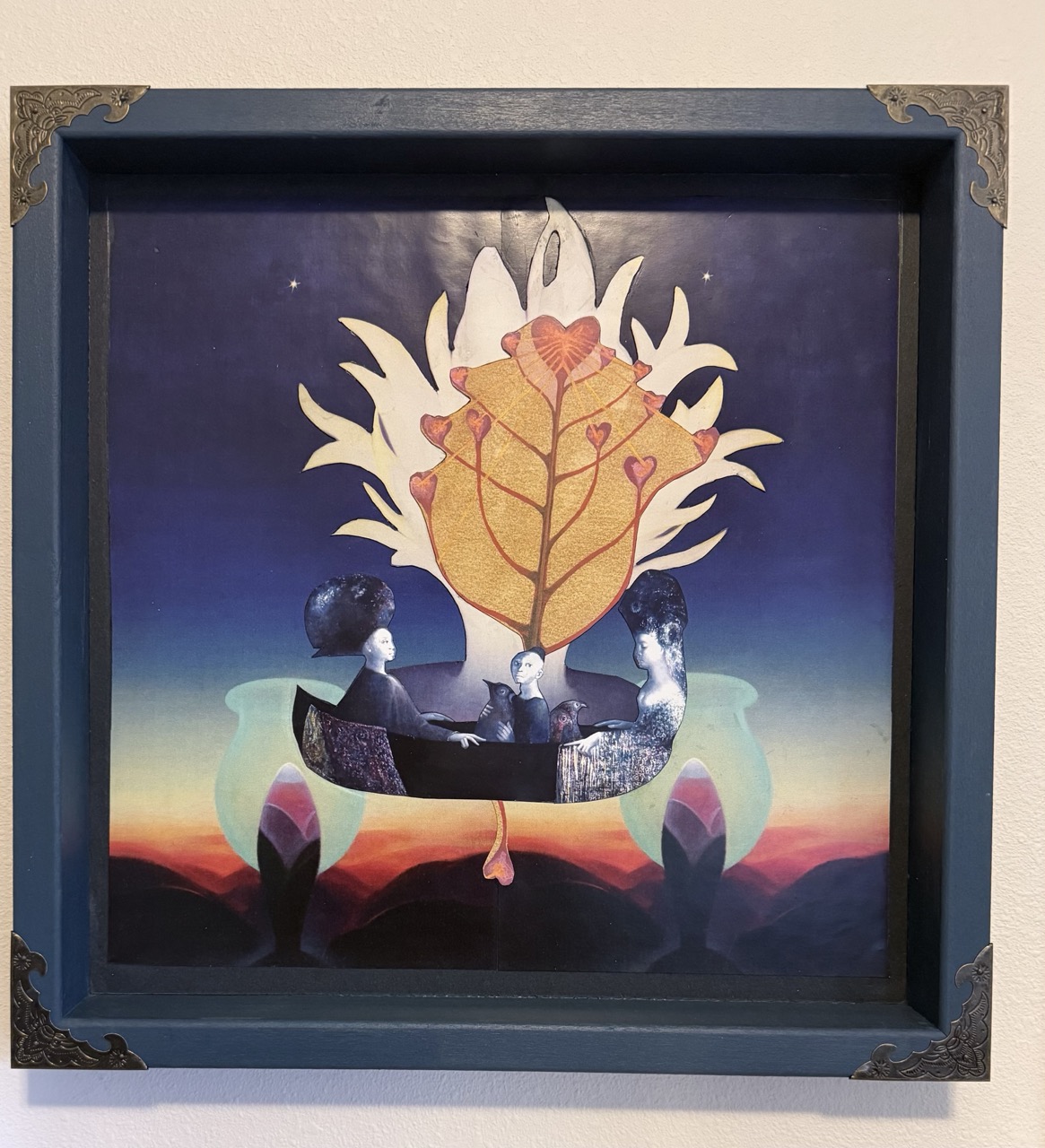
Unmoored, at Midnight in Love gathers its imagery from four visionary women painters, each contributing a piece of the same nocturnal voyage. Rising at the top, the white flame-crown is lifted from Agnes Pelton's The Voice (1930), its petaled eruption suggesting a call heard rather than seen. Flanking the boat, a pair of luminous vessels — mirrored from Pelton's Star Gazer (1929) — stand like twin sentinels holding the horizon's last light. Between them glows the piece's beating center: a gold, vein-threaded heart-tree drawn from Ithell Colquhoun's The Tree of Veins (1940-41), its branches pulsing outward like something both rooted and reaching. And carrying it all forward, adrift beneath a midnight sky, is the canoe itself
- borrowed from Leonor Fini's Voyage sans amarres
(1986), a title that translates to "voyage without moorings." It's Fini's boat, fittingly, that gave this piece its unmoored heart: a vessel with no destination, only a voice ahead calling it on.
A Conversation with the Messengers:
a tribute to Ithell Colquhoun, Remedios Varo and Agnes
Pelton
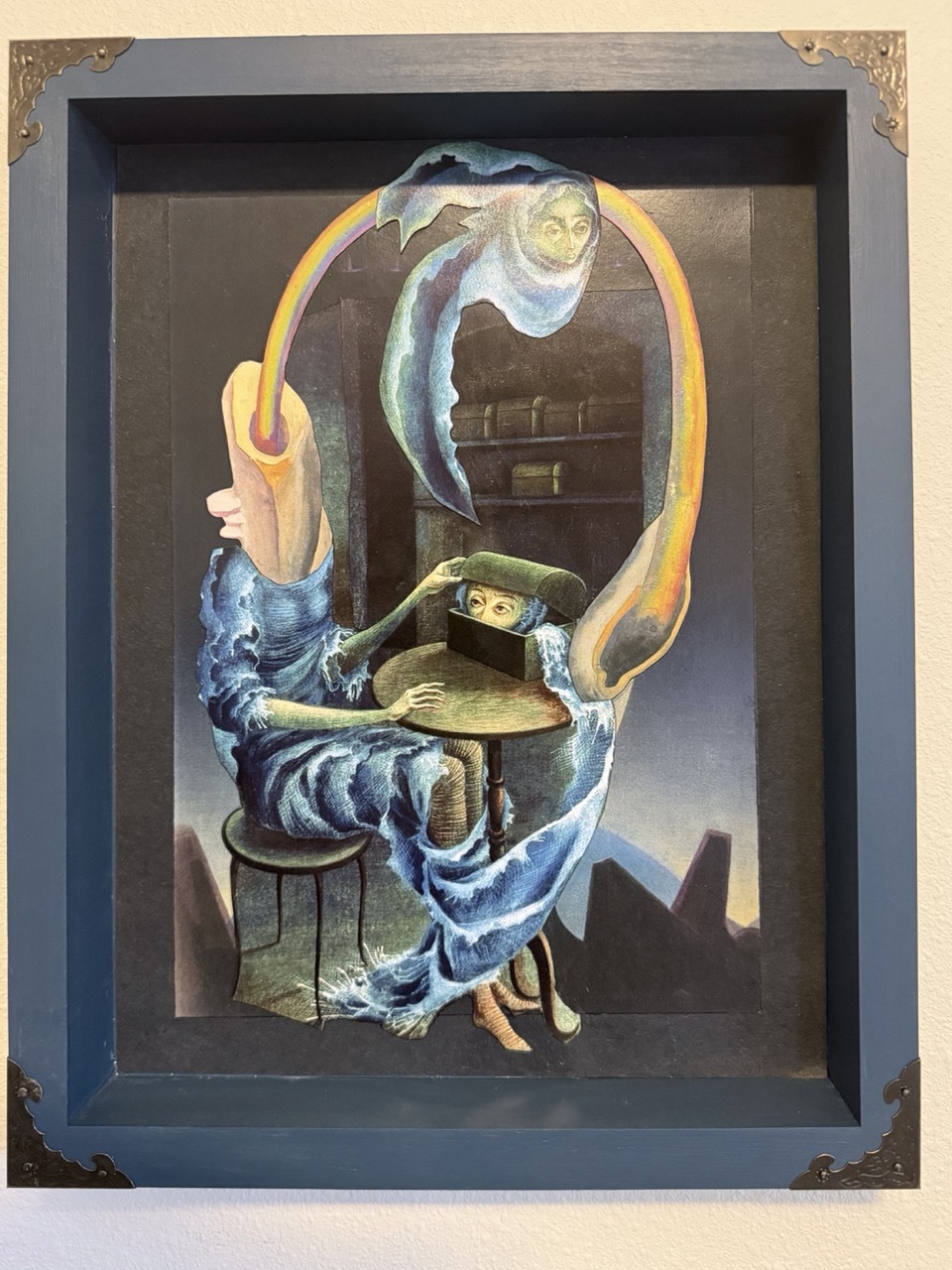
"A Conversation with the Messengers" pairs Ithell Colquhoun's The Trees (1941) with Remedios Varo's Encounter (1959) and Agnes Pelton's Messengers (1932); three women who each painted a boundary opening.
Colquhoun's rainbow, arcing between two hollow trunks, support this figure's head - she thinks through root and spectrum, not only skull. Varo's seated woman, lifting the lid on her own reflected eyes, becomes the body at the table, caught in the act of finding herself. Pelton's messengers move as the current between them. There is no message waiting elsewhere to be delivered. She is the crossing itself - root, rainbow, open box - where receiving and sending are the same gesture."
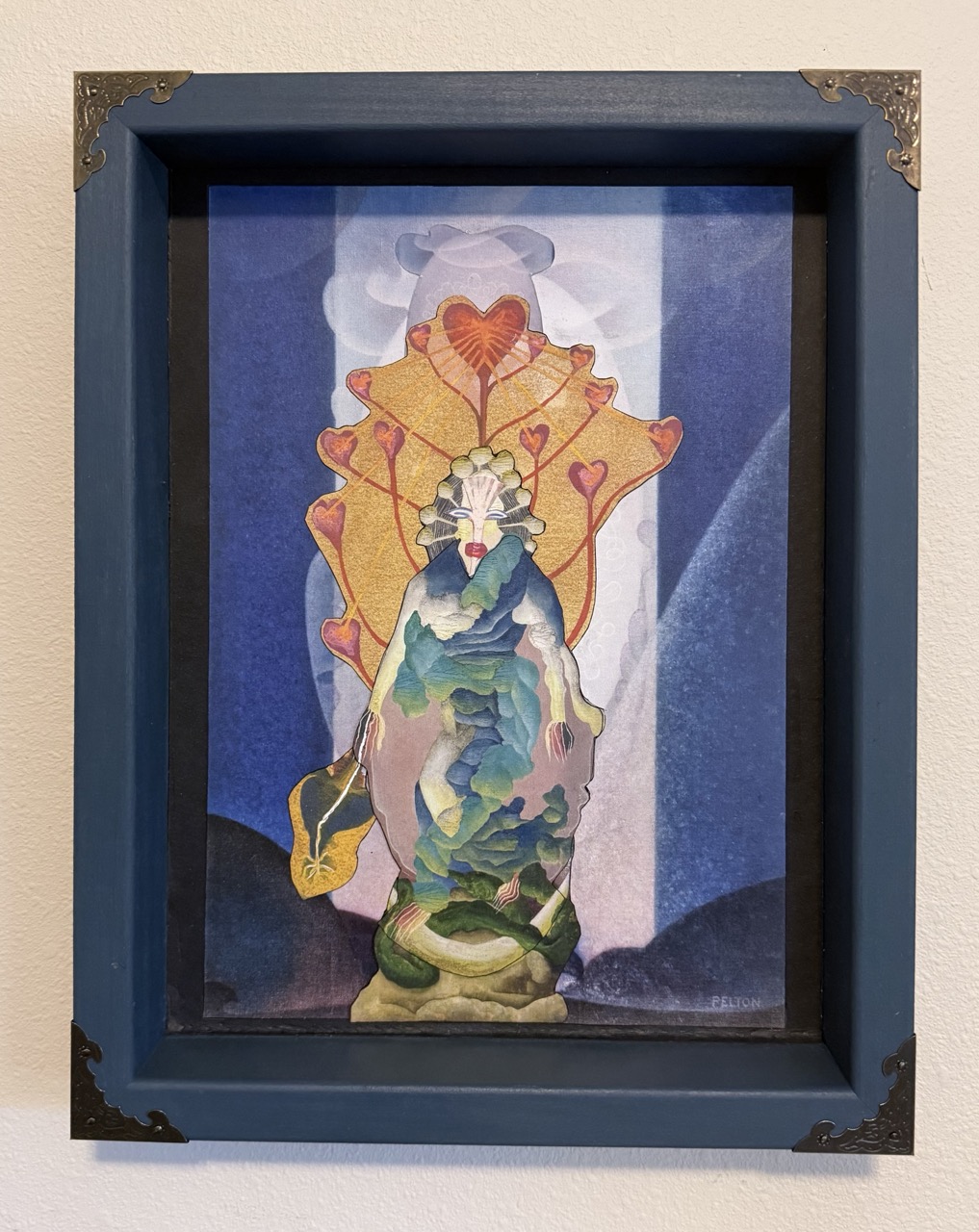
The Mother of Us All: A Tribute to Agnes Pelton and Ithell Colquhoun
Bathed in the pale lunar glow of Agnes Pelton's Light Center
(1947), a figure drawn from Ithell Colquhoun's Attributes of the Moon (1947) rises before a cascade of hearts from Colquhoun's Diagrams of Love: The Tree of Veins I (c.1940-1941), red lines threading from crown to fingertip, a map of feeling made visible.
From the same painting a seed-leaf takes root in her open hand.
She is made of clouds, earth and fire. Her work is tending: the elements rise into the light, then return to quicken the soil. Two visionaries who never shared a room, gathered into one reliquary body: lit by moonlight, mother to a lineage still unfolding.
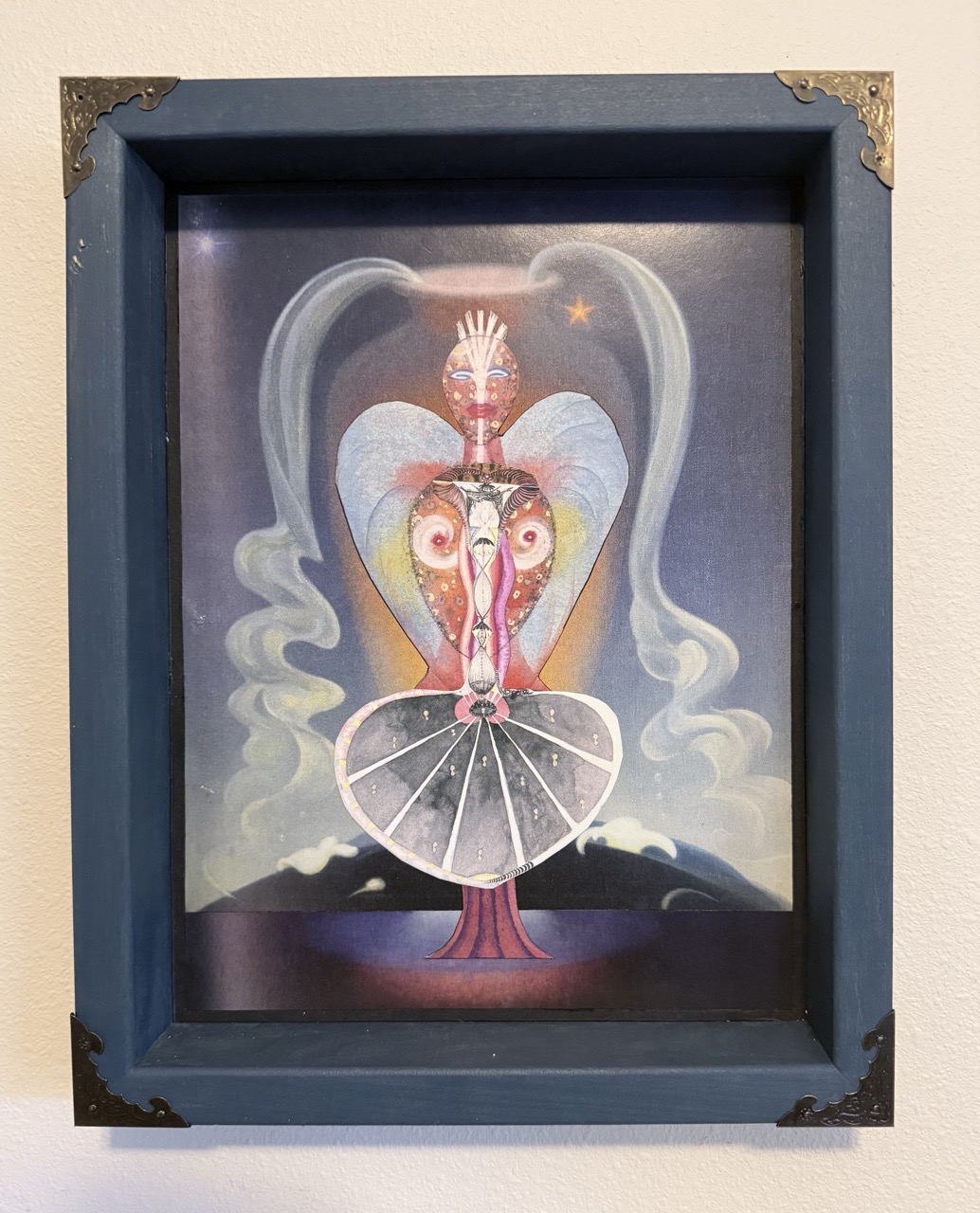
The Transmutation: A tribute to Ithell Colquhoun, Agnes Pelton, and Hilma af Klint
Three visionaries converge into a single figure, caught in the midst of a transformation. Ithell Colquhoun's alchemical union of opposites gives the figure its structure; Agnes Pelton's twilighting atmosphere allows everything to breathe;
Hilma af Klint's mushroom lends its helical stem, tracing how energy moves through a body. All three speak to a single theme: as above, so below, an alchemical truism that was re-introduced during the hermetic revival.
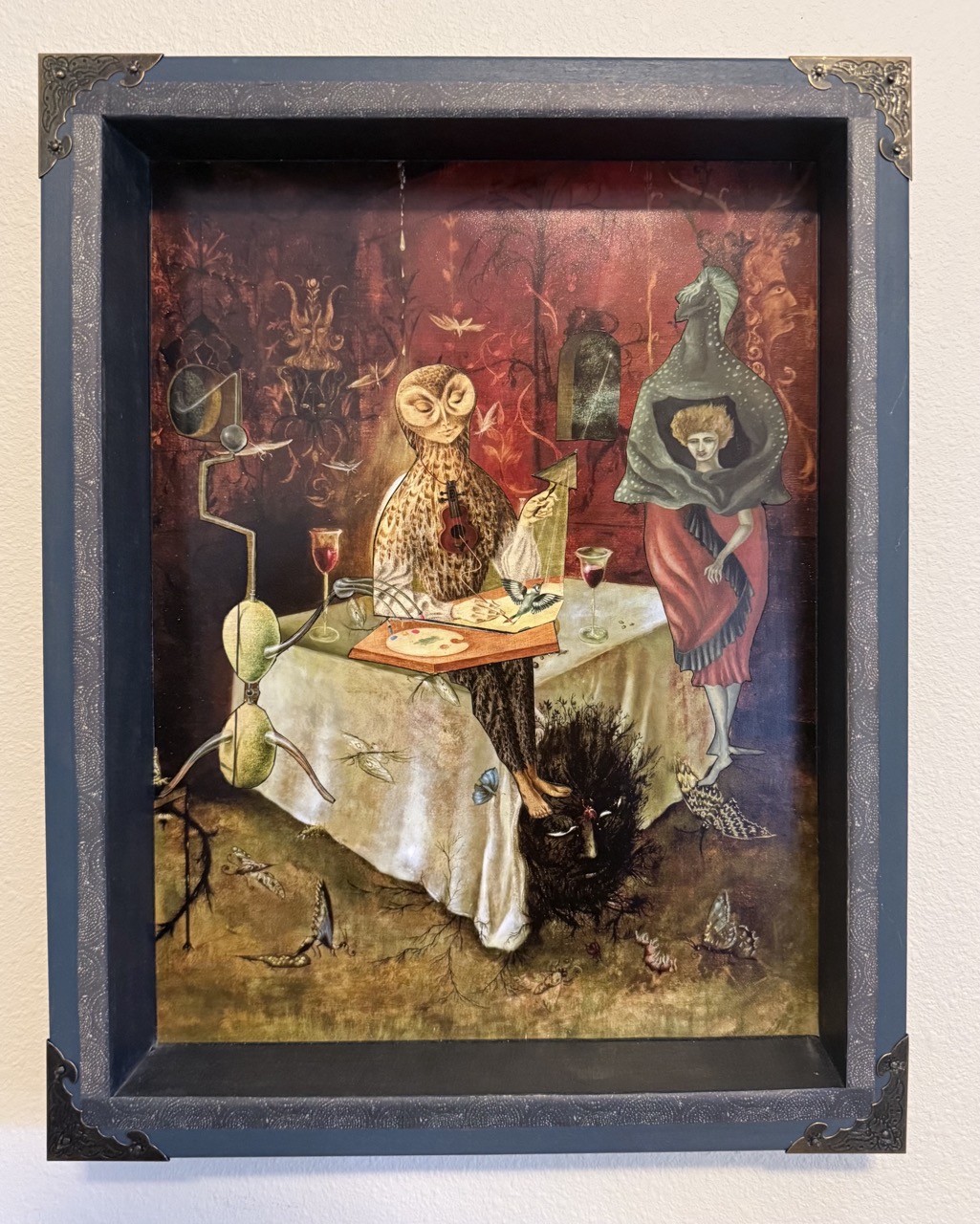
The Reunion: A Tribute to Remedios Varo and Leonora
Carrington
This collage brings together three surrealist masterworks to create a new mythological space. The stage is set within Leonora Carrington's alchemical interior Ab Eo Quod (1956), its Latin inscription warning of hidden transformations. Into this charged space steps the owl-headed Remedios Varo from The Creation of Birds (1957), and to meet her the horse-headed figure from Carrington's own Edwardian Hunt Breakfast
(1956). Together they enact the reunion that history denied them: two women who once drank together, cast spells and painted alongside one another in Mexico City in the 1940s and 50s, now returned to a shared table in an imagined afterlife of artmaking.
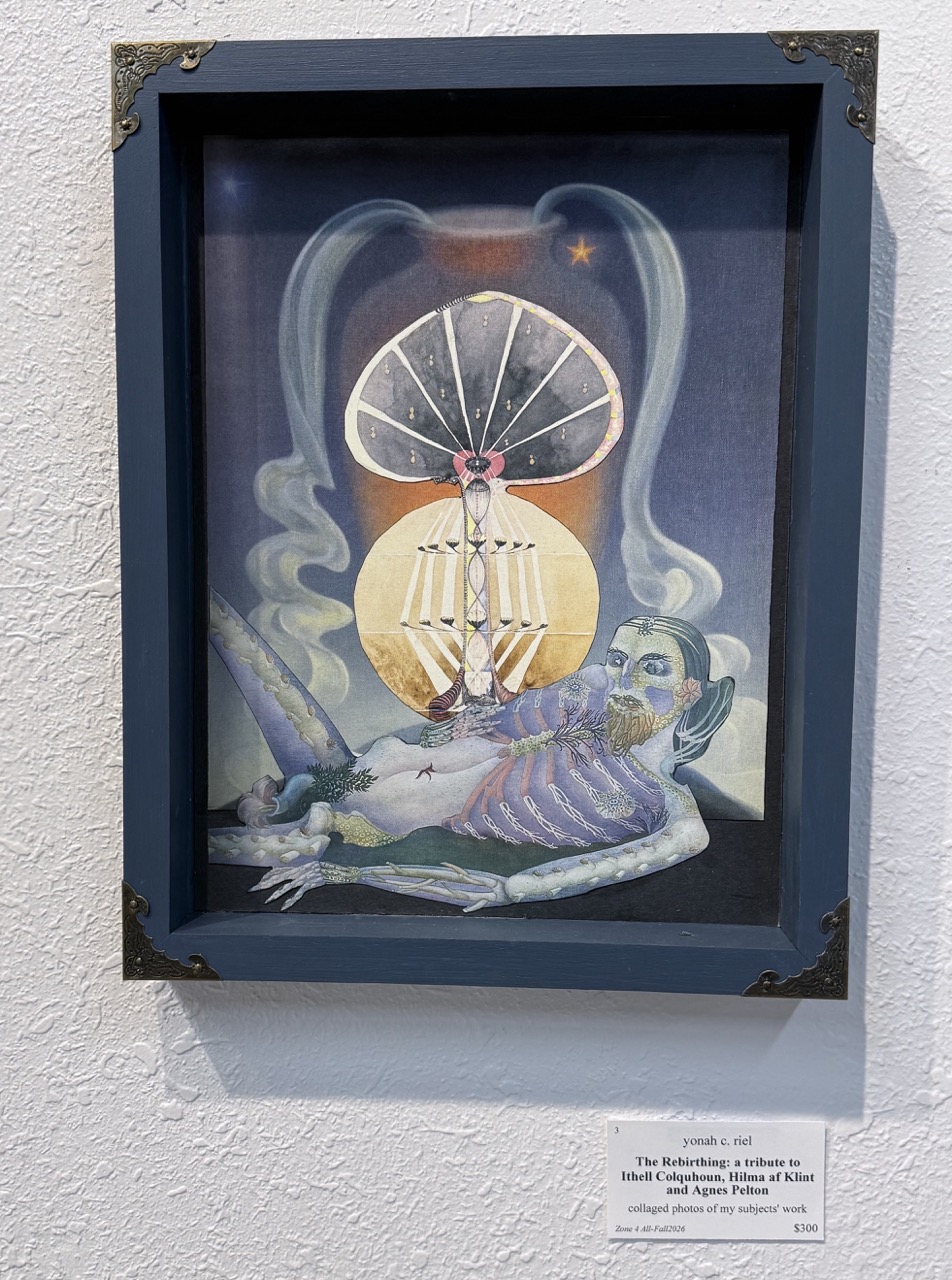
The Cauldron:
A Tribute to Agnes Pelton, Hilma af Klint and Leonora Carrington
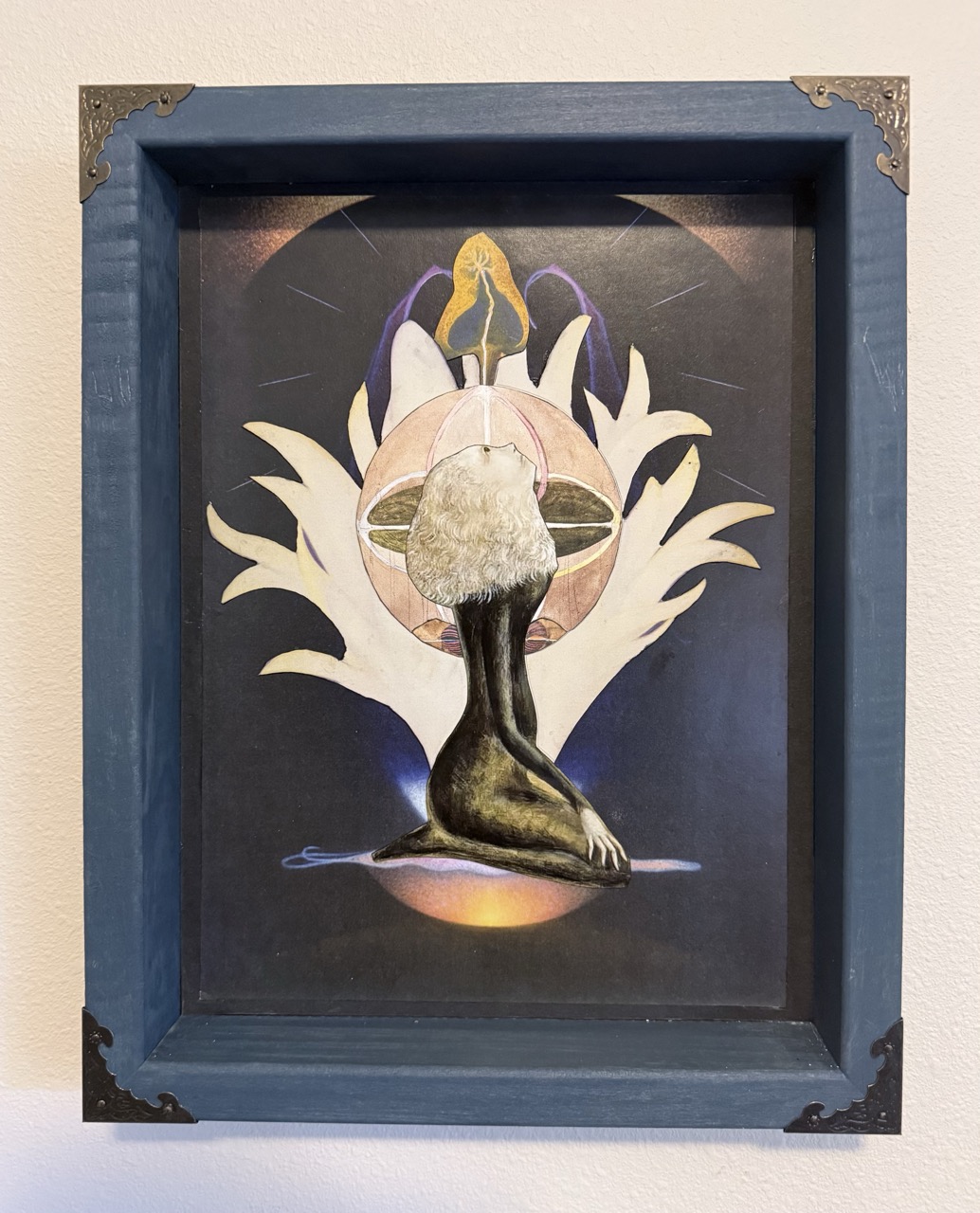
Four artists, working across a century, distill their energies into a single cauldron. Agnes Pelton supplies the both current and the container: her "Alchemy" (1937-39) rises as the purple smoke from a golden glow edging the piece, while her
"'The Voice" (1930) unfurls into the white flames that lick the caudron's rim. At the head sits Hilma af Klint's "Tree of Knowledge" (1913) — a mushroom-crowned heart, the chamber where gathered energies condense before they descend.
And kneeling below, receiving what has been distilled, is a fragment of Leonora Carrington's "The Bath" (El Baño, 1957) - her figure turned inward, spine lit like a wick, transmuting what arrives as current into what she holds as insight.
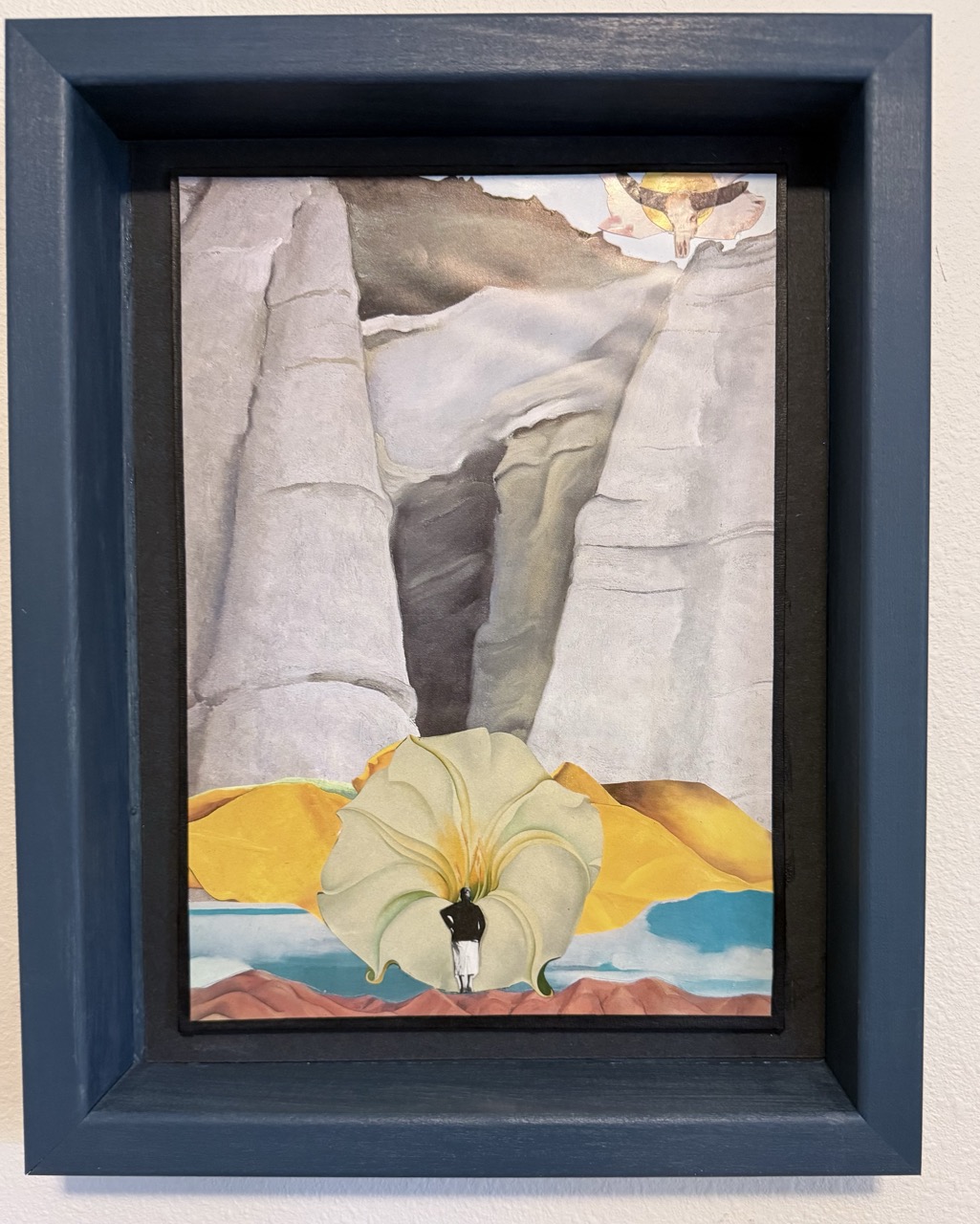
The Portal: A tribute to Georgia O'keeffe
This collage brings together three of Georgia O'Keeffe's most iconic works: the White Place (1940), Jimsonweed (1936) and Summer Days
(1936). They are brought together to create an imagined world in which the artist herself steps into the landscape she made legendary.
A small figure of Georgia stands at the base of her own giant jimsonweed (a portal of sorts) facing the great white cliffs rising before her. Above one of her iconic skulls presides like a watchful spirit. She is at a portal: between human and monumental, between painter and painted, inhabiting once again the world her visions created.
The Convocation:
A Tribute to Leonora Carrington and Remedios Varo
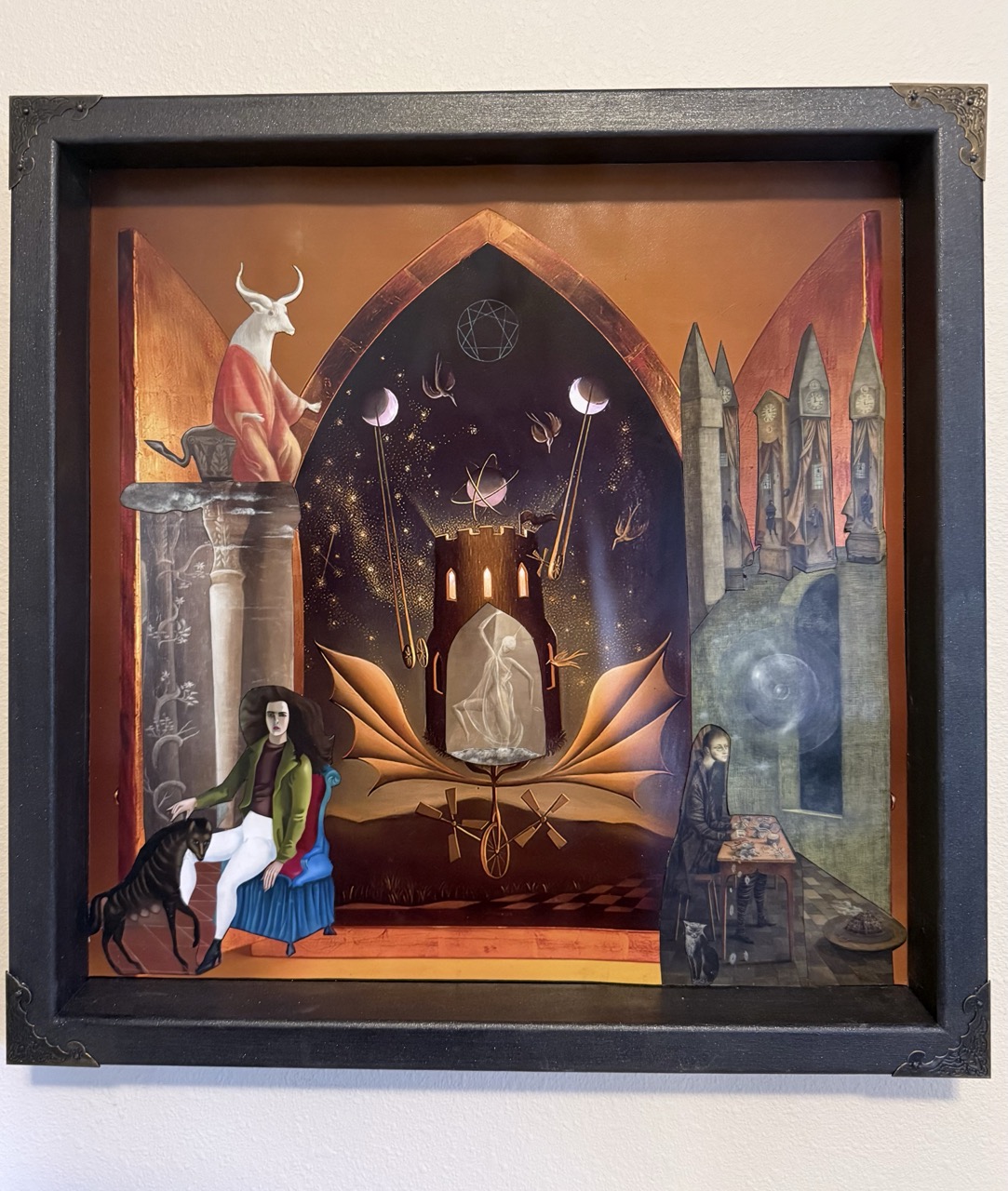
Two Leonora Carringtons appear in this piece. On the left. a young Carrington - Vibrant and unbroken - is drawn from her 1937-38 Self-Portrait (Inn of the Dawn Horse), posed with her pregnant hyena, a declaration of independence made at the very start of her Surrealist career. Above her, the bull-headed figure descends from And Then We Saw the Daughter of the Minotaur (1953), Carrington's later meditation on myth, motherhood, and hybrid identity. On the right, Remedios Varo's solitary timekeeper keeps vigil at the threshold, drawn from her 1955 painting Revelación (El Relojero) - The Clockmaker. Though Varo's original figure is male, her work was always self-referential in spirit, and here the timekeeper is recast as her. Behind her, the celestial architecture is drawn from Varo's Ícono, a devotional altarpiece-format painting from the 1940s in which a winged unicycle carries a tower through a starlit universe — the same cosmic passage that opens at the center of this piece. A sacred space has been called into being. On the left, a young Leonora Carrington, vibrant and unbroken, poses with the pregnant hyena - a declaration of independence. On the right, Remedios Varo's solitary timekeeper keeps her vigil at the threshold. At center, a cosmic arch opens into the starlight, the shared magic of two lifetimes rising from an open book. As in their lives, they dwell in parallel play, each absorbed in her own art, answering the same alchemical call.
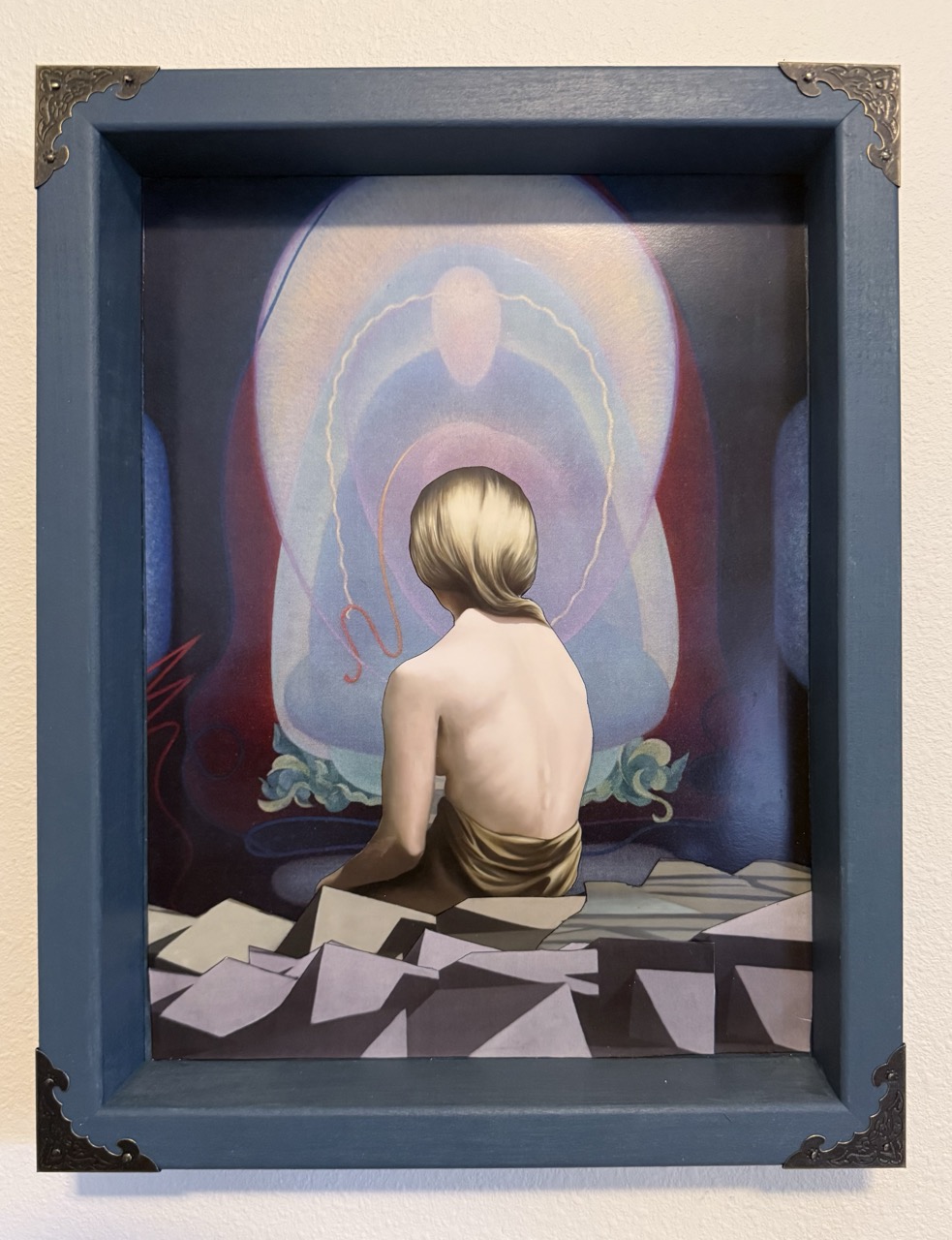
The Passage Reimagined: a tribute to Kay Sage and Agnes Pelton
The central figure in this piece is drawn from Kay Sage's 1956 painting The Passage - created just a year after the death of her beloved husband, the Surrealist painter Yves Tanguy. The original work carries the weight of that grief: stark, bleached, and desolate. Knowing that Sage would take her own life less than a decade later - pressing a gun to her heart as she was losing her eyesight - I felt compelled to offer her a different ending. In this reimagining, her solitary figure moves not through emptiness, but through the luminous inner world of Agnes Pelton's Mother of Silence (1933). Pelton, another visionary and underrepresented woman artist working in the early twentieth century, painted otherworldly light from a place of deep spiritual stillness. Together, these two women - separated by time but united in having been overshadowed - share a quieter, more luminous passage. This piece is an act of imaginative rescue: a softer world for Kay Sage to rest in.